

Most private legal documents and copies of originals require notarization before apostille Ontario to confirm their validity. However, original Ontario vital statistics documents, recent court records, and public post-secondary degrees issued after 2019 are generally eligible for direct authentication without prior notarization.
Navigating the complexities of international document validation in Ontario often leads to a frustrating bottleneck; many applicants are unsure whether their specific paperwork requires a local notary seal before it can receive an apostille. Since Canada joined the Hague Convention, the rules for provincial and federal documents have shifted, creating a landscape where a single procedural error can result in weeks of delays and costly rejections. At Speedy Apostille Services, we understand that your timeline depends on precision. This guide clarifies the new reality of authentication in Ontario by identifying which documents, such as vital statistics certificates, bypass the notary entirely, and which documents, including corporate records or older educational credentials, necessitate a formal notarization first. By following this decision framework, you will ensure your paperwork meets every legal requirement for use abroad without unnecessary hurdles.
The New Reality of Document Authentication in Ontario
Canada officially joined the Hague Apostille Convention in early 2024, a move that fundamentally restructured how documents from Ontario are recognized abroad. For residents in Brampton, Mississauga, and the Greater Toronto Area, the traditional, multi-step process of authentication and embassy legalization has been replaced by a more streamlined apostille system. However, this transition has created a significant point of confusion regarding the necessity of a notary public.
Many individuals assume that every paper requires notarization before apostille Ontario. This misconception often leads to wasted time and unnecessary legal fees. The reality is that the Ontario Official Document Services (ODS) now maintains a digital database of signatures for various provincial officials, allowing certain original documents to bypass the notary office entirely. Submitting a document for notarization when it is not required can occasionally complicate the process or lead to clerical errors that delay your application.
This guide clarifies these new regulations to help you identify exactly when you can skip the notary and go straight to the apostille stage. By understanding these distinctions, you can utilize same-day apostille services more effectively and ensure your international paperwork is processed without rejection. For those seeking Brampton apostille services, professional apostille document guidance ensures your documents meet the exact standards currently required by the province.
Understanding the Difference: Notarization vs. Apostille
The confusion surrounding notarization before apostille Ontario usually stems from a misunderstanding of what each process actually certifies. Notarization is a domestic act performed by a Notary Public. In cities like Brampton and Mississauga, a notary’s primary role is to verify the identity of the person signing a document and to witness that signature in person. They apply their seal and signature to confirm that the act was performed legally within Ontario.
An apostille, by contrast, is an international certification that takes place at the government level. In Ontario, this is handled by Official Document Services (ODS). While a notary verifies the individual signer, the ODS apostille verifies the notary or the public official who signed the document. It proves to a foreign government that the person who signed your document actually holds the authority they claim to have. It is important to remember that an Ontario notary cannot issue an apostille. A notary is often a mandatory first step for private documents, but they cannot provide the final international certification.
Service Step | Performed By | Purpose | ODS Fee (CAD) |
|---|---|---|---|
Notarization | Ontario Notary Public | Verifies identity and signature of an individual | Private fee |
Apostille (Notarized Doc) | Official Document Services | Verifies the authority of the signing notary | $16 per document |
Apostille (Gov. Official) | Official Document Services | Verifies the authority of the provincial official | $32 per document |
Residents seeking Brampton apostille services should note that ODS fee structures vary. While notarized legal documents incur a $16 fee, original government official documents are processed at $32. Navigating these nuances is where professional apostille document guidance becomes invaluable, particularly when utilizing same-day apostille services to meet tight international deadlines.
The Direct Route: Ontario Documents That Do Not Require Notarization

The efficiency of the new system lies in the digital signature database maintained by Ontario Official Document Services. Because ODS already possesses the specimen signatures and seals of various provincial officials, they can verify a document's authenticity without a middleman. For residents utilizing Brampton apostille services, identifying these direct route documents can save both the cost of a legal appointment and the time typically spent at a law office.
The following original Ontario-issued documents generally do not require notarization before apostille Ontario, provided they meet specific issuance criteria and dates:
Vital Statistics Documents: Birth, marriage, and death certificates issued by the Office of the Registrar General are prime candidates for direct processing. While older paper versions may be accepted, modern polymer versions are highly recommended. If you need an apostille birth certificate, ensure you are submitting the original government-issued document rather than a photocopy.
Business Registry Documents: Certificates of status, articles of incorporation, and other filings made under the Business Corporations Act (Ontario) can skip the notary if they were filed on or after October 10, 1991.
Court-Issued Documents: Orders, judgments, or certificates issued by an Ontario court on or after July 10, 2023, are eligible for direct apostille. It is vital to ensure the document bears the original physical or digital seal of the court; without this seal, ODS will reject the application.
Public Post-Secondary Education: Degrees, diplomas, and transcripts from public Ontario universities and colleges issued on or after January 1, 2019, can proceed directly to ODS. This is a significant benefit for recent graduates moving abroad for work or further study.
Document Category | Eligibility Date for Direct Apostille | Essential Requirement |
|---|---|---|
Vital Statistics | Any (Polymer preferred) | Must be an original issued by the Registrar General |
Business Filings | On or after October 10, 1991 | Filed under the Business Corporations Act |
Court Records | On or after July 10, 2023 | Must bear the official court seal |
Public Education | On or after January 1, 2019 | Must be from a public post-secondary institution |
Skipping the notary for these items is possible because the provincial government already has the issuing official’s authority on file. When providing apostille document guidance, we prioritize verifying these dates to prevent our clients from paying for unnecessary notarizations. However, these rules apply strictly to the original documents. If your paperwork predates these milestones, or if you only have a copy, the process reverts to the standard notarization requirement. Utilizing same-day apostille services is most effective when the documents are correctly categorized at the outset.
The Notary Required List: When You Must See a Notary Public First
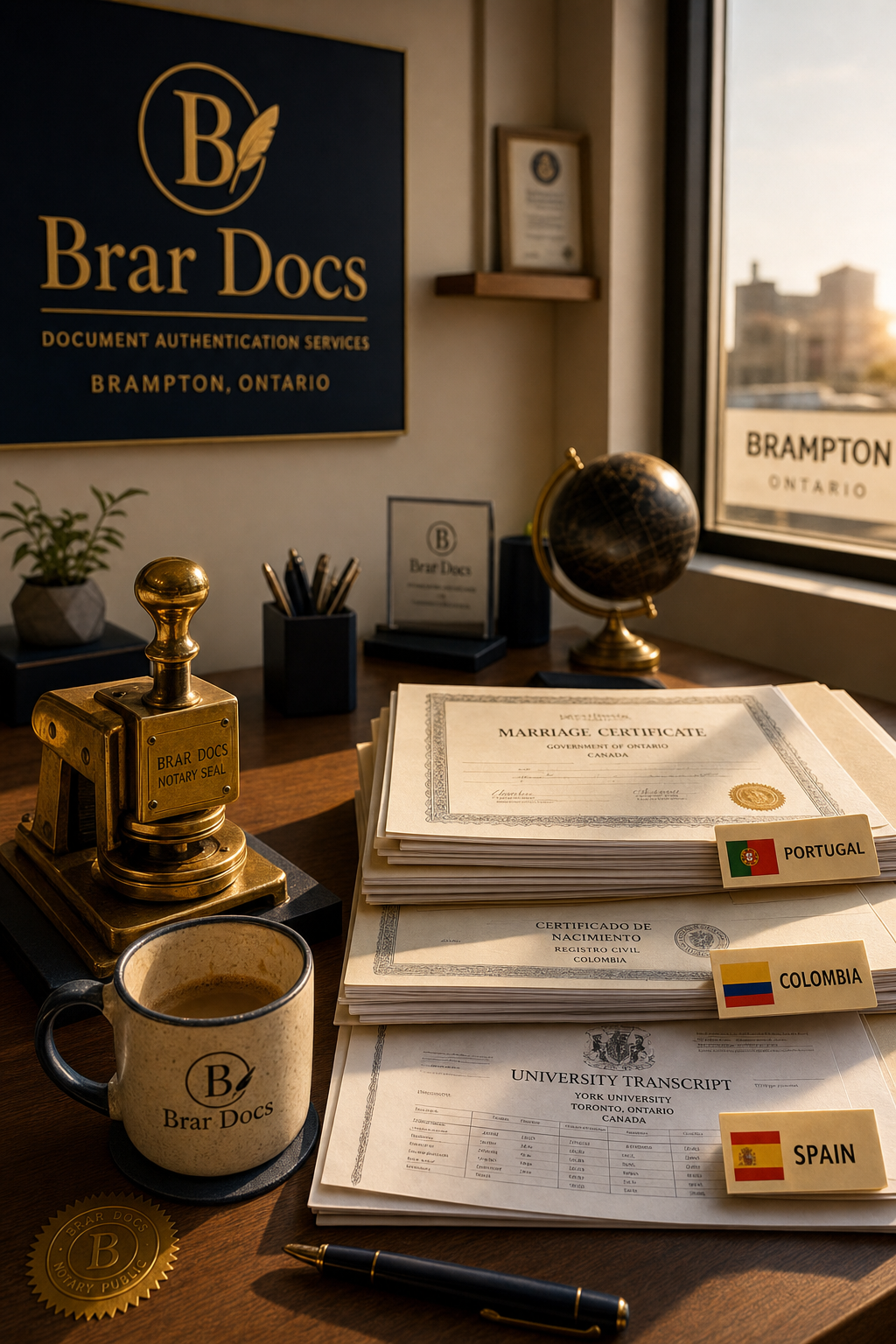
While many original provincial records enjoy a direct path, the vast majority of personal and commercial legal paperwork requires notarization before apostille Ontario. This step is non-negotiable for documents where a government official’s signature is not already on file with Official Document Services. For residents in Brampton and Mississauga, failing to secure a notary seal on these specific items will result in an immediate rejection by provincial authorities.
Private legal documents form the bulk of this list. Because these are drafted by individuals or private legal professionals rather than government bodies, their authenticity must be verified by a Notary Public before the province can issue an apostille. The following documents always require notarization:
Powers of Attorney (POA): Documents granting legal authority over property or personal care to another individual.
Affidavits and Statutory Declarations: Sworn statements used for legal proceedings or identity verification.
Consent Letters for Children Traveling Abroad: Required when a child is traveling with only one parent or another guardian.
Private Business Records: Employment contracts, commercial invoices, and corporate bylaws that have not been filed with the provincial registry.
Document Type | Notarization Requirement | Why It Is Required |
|---|---|---|
Power of Attorney | Mandatory | Verifies the identity of the person granting authority |
Travel Consent Letter | Mandatory | Confirms the parent's signature is authentic |
Certified True Copy | Mandatory | Confirms a photocopy is an identical match to the original |
Private Contract | Mandatory | Establishes the validity of private signatures |
A critical distinction often overlooked involves the use of copies. Even if a document, such as an original birth certificate, is eligible for the direct route, a photocopy of that same document is not. If you choose to submit a 'certified true copy' rather than the original government-issued polymer version, that copy must be notarized first. This is a common point of failure for DIY applications. When providing apostille document guidance, we ensure clients understand that the format of the document determines the procedural path. Utilizing same-day apostille services is only possible when these preliminary notarizations are correctly executed. For those requiring Brampton apostille services, verifying the status of your document as either a private record or a certified copy is the first step in avoiding processing delays.
Date Deadlines: Why Your 2018 Degree Still Needs a Notary
The effectiveness of the Ontario apostille system relies on a central database of digital signatures. When a document predates the system’s records, Official Document Services (ODS) cannot verify the issuing official's authority without an intermediary. This is why a degree issued in late 2018 requires notarization before apostille Ontario, while the exact same credential issued in early 2019 does not. The January 1, 2019, cut-off for public post-secondary documents is a hard line; if your graduation date is even one day prior, you must visit a notary first.
This logic applies across various document categories. Court-issued documents from June 2023, for example, must be notarized because they fall before the July 10, 2023, integration date. Without a notary’s current seal, ODS has no protocol to validate the older court official’s signature. Older business filings dating before October 10, 1991, also fall outside the direct verification window and require a notary's intervention to be recognized.
Document Category | Cut-off Date | Status of Older Documents |
|---|---|---|
Public Post-Secondary | Jan 1, 2019 | Notarization Mandatory |
Court Records | July 10, 2023 | Notarization Mandatory |
Business Registry | Oct 10, 1991 | Notarization Mandatory |
Navigating these specific dates is essential to avoid processing delays. For residents using Brampton apostille services, receiving accurate apostille document guidance regarding these deadlines prevents the frustration of a rejected application. When time is critical, utilizing same-day apostille services ensures that even older documents are notarized and processed through the correct channels without technical setbacks.
How to Handle Federal vs. Provincial Documents in Ontario

Identifying the issuing authority is just as critical as checking the document date. Ontario documents, such as birth certificates or local court orders, are handled by Official Document Services (ODS) in Toronto. Conversely, documents issued by federal agencies follow a separate jurisdictional path through Global Affairs Canada (GAC) in Ottawa. Sending a federal document to the provincial office is one of the most frequent causes of processing rejection for residents in the Greater Toronto Area.
RCMP fingerprint based criminal record checks, Canada Revenue Agency (CRA) tax residency certificates, and federal incorporation papers under the Canada Business Corporations Act must be routed through GAC. While ODS has established direct routes for many provincial originals, federal documents often still require notarization before apostille Ontario can be finalized by GAC, particularly if the document is a certified copy or a private corporate record.
Issuing Authority | Primary Jurisdiction | Common Documents |
|---|---|---|
Provincial (Ontario) | Official Document Services (ODS) | Birth certificates, Ontario diplomas, Court orders |
Federal (Canada) | Global Affairs Canada (GAC) | RCMP checks, CRA certificates, Federal incorporations |
Speedy Apostille Services specializes in triaging these requirements to prevent paperwork from being sent to the wrong office. We provide apostille document guidance to ensure your Brampton apostille services application targets the correct government body. By leveraging our same-day apostille services, clients avoid the weeks of delay typically caused by jurisdictional confusion and technical rejections.
Common Questions About Ontario Notarization and Apostille
Understanding these jurisdictional boundaries is only the first step; practical execution often brings up specific logistical questions. One of the most frequent inquiries involves who can notarize an apostille birth certificate. For original polymer certificates issued by the Ontario Registrar General, the answer is usually no one; the document is already eligible for direct submission. If you choose to use a photocopy instead of the original, an Ontario Notary Public must certify it as a true copy before it can proceed to Official Document Services (ODS).
Skipping required notarization before apostille Ontario leads to an automatic rejection by ODS. When a document arrives without the necessary notary seal, the provincial office cannot verify the signature, causing the application to be sent back. This error can add weeks to a process that should take days. For those utilizing same-day apostille services, a preliminary review is essential to confirm that all private or older documents bear the correct legal stamps.
Common Issue | Result of Skipping Notarization | Actionable Solution |
|---|---|---|
Private Power of Attorney | ODS Rejection | Must be signed before an Ontario Notary |
Pre-2019 Diploma | Application Returned | Secure a notarized certified copy |
Photocopy of Passport | Processing Delay | Notarize as a 'certified true copy' |
Residents seeking Brampton apostille services should prioritize local providers who offer comprehensive apostille document guidance. Having a professional review your document's issuance date and type before you travel to Toronto or submit by mail prevents the common pitfalls of the new Hague Convention regulations. Local processing in the Greater Toronto Area ensures that errors are caught before they become costly delays.
Understanding which Ontario documents require a notary and which are ready for authentication is the first step toward a successful application. Navigating these specific provincial requirements can be complex, especially when deadlines are tight. If you want expert help to ensure your paperwork meets all legal standards without any added stress, our team is here to streamline the process for you. To better understand the specific requirements for your situation, you can review our Apostille Guide to help simplify your next steps.